
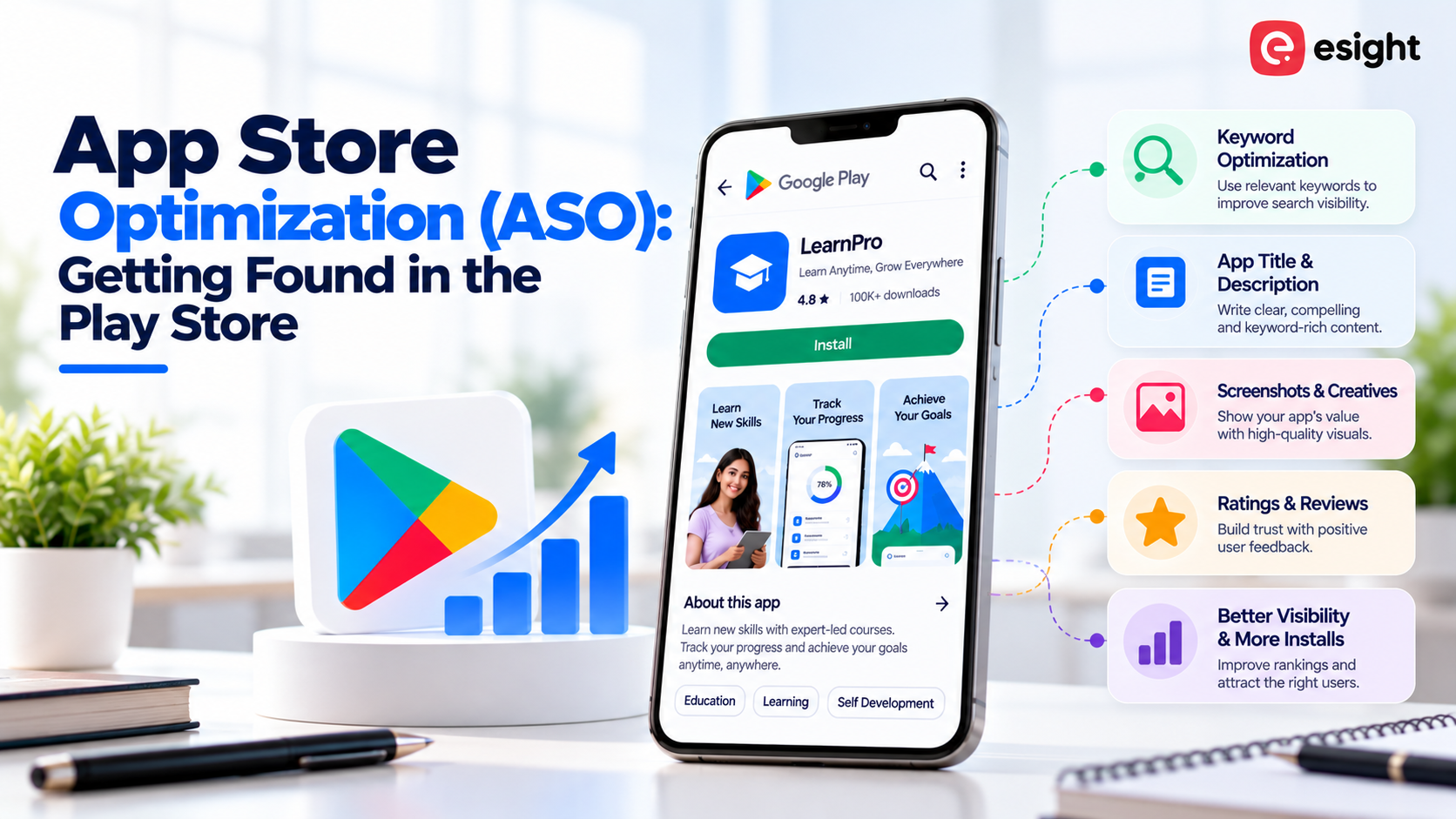
App Store Optimization, or ASO, is the work of making an Android app easier to find and more tempting to install on Google Play. Many users discover apps through store search, so a weak listing hides even a well-built product. This guide explains how Play Store search works, which listing elements carry weight, how ratings and quality shape visibility, and how to measure progress.
What Is App Store Optimization and How Does Google Play Search Work?
What ASO means for an Android app
App Store Optimization is the process of improving an app’s store listing so it appears for relevant searches and convinces visitors to install it. It covers metadata, visual assets, ratings and quality signals, and works on two fronts: search visibility and install conversion. Unlike website SEO, the listing itself acts as the landing page.
How Google Play decides which apps to show
Google Play matches a search query against listing text, then weighs engagement and quality signals such as installs, ratings, uninstall behaviour and stability. Relevance gets an app into the results. Performance data decides how high it stays. No single factor guarantees a position, and results differ by category and competition.
Why Play Store Visibility Matters for Different Businesses
Organic installs cost nothing per click, which makes store search valuable for every business size. The benefit takes a different shape for each sector:
E-commerce stores turn browsers into repeat buyers through a dedicated shopping app.
Small businesses reach nearby customers without a large advertising budget.
Medium and large businesses support wider customer bases and service portals.
Edtech platforms attract learners searching for courses and exam preparation tools.
Health clinics let patients book appointments and access records from one place.
Other service businesses simplify bookings, payments and customer support.
Core Elements of a High-Ranking Play Store Listing
App title and short description
The title carries strong search weight and allows 30 characters. Place the main term there, next to the brand name. The short description allows 80 characters and works as a headline, so it should state the main benefit in plain language.
Full description and keyword placement
The full description allows up to 4000 characters. Write it for readers first, with the opening lines covering what the app does and who it serves. Use related terms and natural phrases across the text. Repeating the same words in a list goes against Google Play policy and weakens trust.
Icon, screenshots, feature graphic and promo video
Visual assets drive the decision to install. Review these assets:
Icon: simple, recognisable at small sizes and consistent with the brand.
Screenshots: the first two should show the core benefit, with short captions.
Feature graphic: a clean banner that supports the app’s main message.
Promo video: a short walkthrough of the main task users complete.
Category selection and tags
Choose the category that matches the app’s primary purpose in Google Play Console, then add accurate tags. A mismatched category confuses both the algorithm and the visitor.
Ratings, Reviews and App Quality Signals
How ratings and reviews affect ranking and conversion
Ratings influence whether a visitor taps install, and review text can give Google Play extra context about what the app does. Replying to reviews shows users that feedback gets read. Never buy or fake reviews, because policy enforcement can remove the app.
Technical quality and Android vitals
Android vitals in Google Play Console reports crash rates, ANR (application not responding) rates, startup time and battery use. Poor numbers can reduce visibility and lower user trust.
Key quality signals include:
Low crash rate across devices
Few ANR events
Fast startup
Regular updates with clear release notes
Strong ASO works best on top of a stable product. Esight Solutions builds Android apps with performance and onboarding in mind, which supports the retention figures that app owners track.
Localisation and Regional Targeting for Kerala Businesses
Localisation means adapting the title, descriptions and screenshots for a specific language and audience. Listings in Malayalam, Hindi or English let users read the pitch in the language they search in. Screenshot captions in the local language can make the benefit clearer.
Brands planning mobile app development in Kerala should also study the search terms used by regional audiences, since local vocabulary and device preferences shape how people phrase queries.
Google Play Console supports translated listings and country availability settings, so each listing can match the market it serves.
How to Measure and Improve Your ASO Results
Metrics worth tracking
Google Play Console reports the numbers that show where a listing succeeds or fails:
Impressions: how often the app appeared in search and browse.
Store listing visitors: people who opened the listing page.
Install conversion rate: the share of visitors who installed.
Installs by source: search, browse or external referrals.
Uninstall rate and retention: whether users keep the app.
Testing and updating the listing
Store listing experiments let developers test icons, screenshots and descriptions against real traffic before applying a change. Test one element at a time so the result is clear. Update the listing after major releases, seasonal campaigns or changes in user search behaviour, and review the data monthly.
Frequently Asked Questions
What is ASO in simple terms?
ASO is the practice of improving an app’s Google Play listing so more people find it and install it. It combines keyword relevance in the text with strong visuals, ratings and app quality, working like SEO designed for app stores.
How long does ASO take to show results?
Small metadata changes can affect impressions within days or weeks, but ranking shifts depend on competition, category and user behaviour. Treat ASO as steady work and compare results over several weeks before judging a listing change.
Is ASO a one-time task?
No. Search trends, competitors, Google Play features and user expectations keep changing. Regular reviews of keywords, screenshots, descriptions and release notes keep a listing accurate and competitive, especially after major app updates or new feature launches.
How many keywords should a Play Store listing use?
No fixed number exists. Focus on one primary term in the title and a few related phrases that fit naturally in the descriptions. Clear, readable text serves users better than crowded keyword lists and stays within Google Play policy.
Conclusion
Play Store visibility depends on relevant metadata, persuasive visuals, healthy ratings and a stable app. Track the numbers in Google Play Console and refine the listing steadily. Businesses seeking a mobile application development company in Kochi can work with Esight Solutions to build and prepare apps for strong store performance.
Let’s Build Something Powerful
Tell us about your business challenge. We’ll tell you how we’d solve it.