
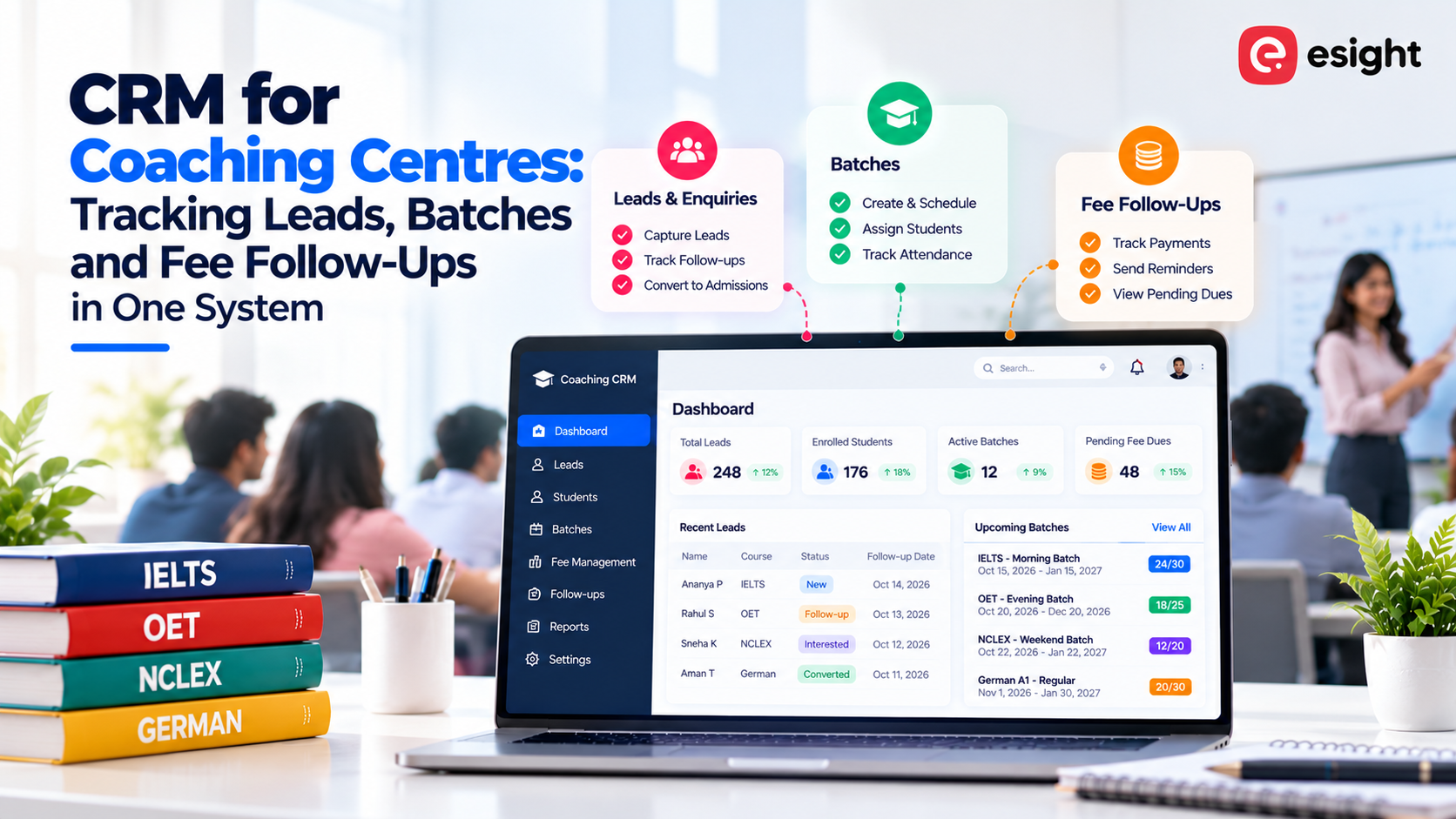
Enquiries arrive through calls, walk-ins, social media and website forms, while batch lists and fee dues sit in registers and spreadsheets. That scattered setup costs coaching institutes admissions and payments. A CRM for coaching centres brings enquiry handling, batch allocation and fee reminders into one workspace. This blog explains how it works, who uses it, when to adopt it, which features matter and how to choose a development partner.
What Is a CRM for Coaching Centres?
A customer relationship management system for an institute stores every prospect and student record in one database. It links each enquiry to a counsellor, a course, a batch and a fee plan. Typical records include leads, students, parents, courses, batches, faculty and payments.
Unlike a spreadsheet, it records every call, message and payment with a timestamp, so nobody depends on memory or a paper register. Education CRM tools also add reminders, dashboards and role-based access.
Why Scattered Records Cost Admissions
Coaching institutes run on timing. A parent who enquires in the evening expects a reply within hours, and a delayed answer sends them to a competitor. Common gaps include:
Enquiries noted on paper and never entered anywhere
No record of which counsellor promised a callback
Batch seats sold twice because lists are not shared
Installments forgotten until the accountant checks the ledger
A lead management system closes these gaps by making every pending task visible to the right person.
How Lead Tracking Works
Capturing Enquiries From Every Source
The system collects enquiries from website forms, social media ads, WhatsApp, phone calls and walk-ins, then tags each one with its source. Source tags show which channel brings admissions and which only brings traffic. Duplicate detection prevents the same phone number from creating two records.
Stages, Assignment and Follow-Up Schedules
Each lead moves through stages such as new, contacted, demo attended, counselled and admitted. Rules assign leads to counsellors by course or workload. Every stage change triggers a follow-up date, and overdue tasks appear on the counsellor’s dashboard.
Managers then compare enquiry-to-admission rates across sources and staff. Useful measures include source-wise conversion, batch fill rate, fee collection rate and dropout rate, all calculated from live records.
Managing Batches Without Timetable Clashes
Batch management software stores course, schedule, faculty, room and seat capacity for every batch. When a lead is ready to enrol, the counsellor sees open seats instantly. The system blocks over-allocation and can hold a waitlist for full batches.
It also lets staff transfer a student between batches and keeps attendance and fee data attached to the right record. Batch-wise reports show fill rate and dropout patterns.
Fee Follow-Ups That Run on Schedule
Fee management software stores the fee structure, discounts and installment plan for each student. Reminders go out automatically before and after every due date through WhatsApp, SMS or email. Key capabilities include:
Payment links inside reminder messages
Instant digital receipts
Overdue lists sorted by amount and age
Concession records with approval history
Collection reports by batch and month
Accountants spend less time chasing balances, and owners see cash flow without waiting for month-end reports.
Where CRM Meets ERP and Who Uses Each Module
CRM covers the pre-admission and communication side. ERP covers accounts, payroll, inventory, timetables and academic records. Centres with several branches often need both connected, and an erp development company in kochi can build them as one platform with shared student data.
Different roles use different modules:
Owners: dashboards and collection reports
Counsellors: lead pipeline and follow-ups
Front office: enquiry entry and receipts
Accountants: fee ledgers and overdue lists
Faculty: batch lists and attendance
The same pipeline logic suits clinics, edtech platforms and e-commerce stores, where enquiries and payment reminders also need tracking.
When to Move Away From Manual Tracking
Move when enquiry volume outgrows one person’s memory. Other signals include multiple branches, several parallel batches, rising overdue fees and staff turnover that erases follow-up history. Starting early is easier, because less data needs migrating, and the team builds the habit of logging every interaction from day one.
How to Choose a Software Partner
Compare crm software development companies on these points:
Customization for your fee plans and batch rules
Role-based access and data security
Integration with WhatsApp, SMS and payment gateways
Reporting depth and export options
Training, support and migration help
Ability to scale to new branches or courses
Ask for a demo using your own workflow. Student and parent data is personal information, so confirm how the vendor stores, encrypts and backs it up.
Esight Solutions develops custom software for education and service businesses, which suits centres whose processes do not fit ready-made tools.
Conclusion
Tracking leads, batches and fee follow-ups in one place gives a CRM for coaching centres its value: faster replies, full seats and steady collections. Esight Solutions can map these workflows into a custom system. Share your requirements with the team to explore a tailored solution.
FAQs
What does a coaching institute CRM do?
It records enquiries, assigns follow-ups, allocates batches and sends fee reminders from one dashboard. It replaces registers and scattered spreadsheets with a single, searchable database.
Is a CRM different from ERP software?
Yes. CRM manages enquiries, communication and admission follow-up. ERP manages accounting, payroll, academics and operations. Many institutes connect both.
Can a small centre use a CRM?
Yes. Small centres benefit from enquiry tracking and fee reminders even with one or two batches. Most systems scale as branches and courses grow.
How are installment reminders sent?
The system schedules messages by due date and sends them through WhatsApp, SMS or email, often with a payment link. Staff can see which reminders were delivered.
How long does setup take?
Timing depends on customization and data volume. A standard setup can run within weeks, while custom workflows and data migration need more time. Confirm the schedule with the provider.
Let’s Build Something Powerful
Tell us about your business challenge. We’ll tell you how we’d solve it.